

‘Cuban drone crisis?’ FIU experts, policy leaders discuss security at United Against Nuclear Iran event
The first-ever public display in Florida of an Iranian-made Shahed-136 drone was held during a press conference by United Against Nuclear Iran (UANI), a nonprofit policy organization formed to combat threats posed by the Islamic Republic of Iran.
Joining former Florida Governor Jeb Bush, who chairs the group, and other officials for follow-up discussion were FIU engineering faculty with expertise in the technology. Much of the conversation centered around the potential impact of such devices much closer to home.
UANI CEO Mark Wallace and Congressman Carlos Gimenez referred to the possible “Cuban drone crisis” threat emerging from public reports.
“We feel that there are approximately at least 300 of these in Cuba,” said Gimenez, who serves on the House Armed Services Committee and the House Homeland Security Committee.
Gimenez, who recently helped secure $2.1 million in federal funding for FIU for national security innovation, emphasized that the U.S. is working on effective, cost-efficient defenses to knock down the drones.
As a research and workforce development hub, FIU is increasingly stepping up to partner on emerging national security issues. Following the public press conference, FIU experts and students met privately with the leaders to discuss research and trends in national security and drone defense.
FIU faculty and staff presenters included:
- Mike Asencio, the director of the Cyber Policy Program at the Jack D. Gordon Institute for Public Policy
- Professor John Volakis, an expert on wireless communication technology at the College of Engineering & Computing
- Professor Mohammad Ashiq Rahman, a cybersecurity researcher and associate director of FIU’s Center for Integrated Security, Privacy, and Trustworthy AI
- Mariya Shevchenko, a master's student studying public administration and a member of the Gordon Institute National Security Student Fellow 2025-2026 Cohort
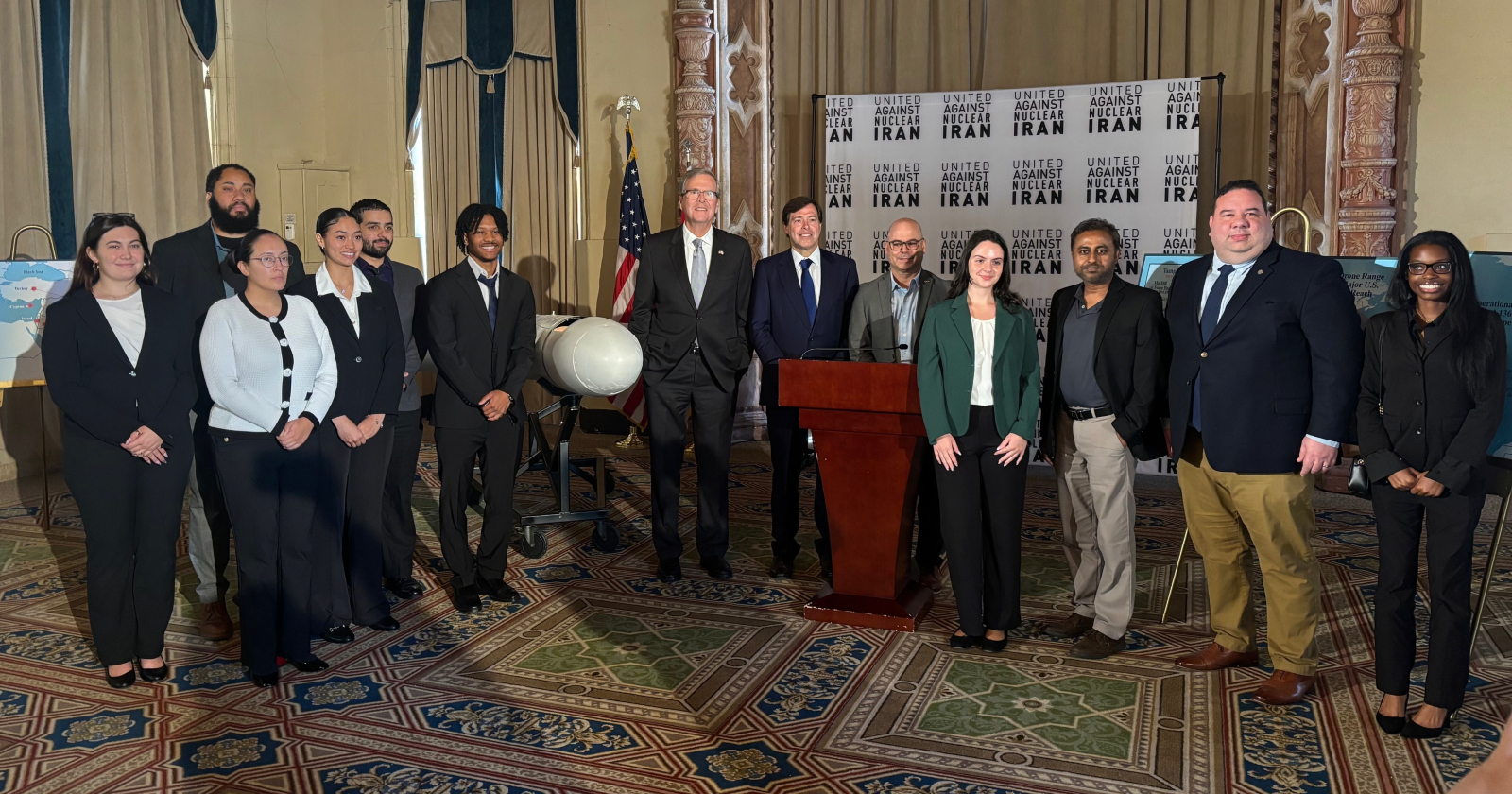
FIU currently conducts research and programming with funding from the Department of Energy, Department of War and the National Security Agency, and has built trusted relationships with federal policymakers, national security practitioners and leading organizations like UANI. FIU faculty and researchers have unique knowledge, hardware and software technologies to track, guide and navigate drones securely.
After last week's event, FIU News caught up with two of the university’s presenters for their analyses on what drones close to home might mean.
Exploring how drones can be compromised
Downing drones can be difficult, especially when they are launched in groups. Rahman, who researches drones at FIU’s College of Engineering & Computing, explores how these weapons can be compromised through cyber-attacks and unconventional means.
One security aspect of drones he looks at is supply chain vulnerability. In a multi-national drone production process, a rogue actor can slip in a faulty part or program that causes a drone to malfunction when operating, which often bypasses a drone’s typical defenses at the network or sensor level. However, that vulnerability might not apply to Iranian-made weapons, he says.
“The odds are that this level of drone can be built entirely within their country," Rahman said, examining the Shahed-136 up close. "They probably don't need to bring components from other places."
Looking for a ‘Strait of Hormuz’ in the Western Hemisphere
Given that Cuba is positioned in between the Gulf of America, the Straits of Florida and the Caribbean Sea, is the country in a position to disrupt the global economy by firing drones on shipping routes?
Shevchenko, who studies Iran’s proxy groups as part of her research as a graduate of JGI's Undergraduate National Security Studies Certificate, sees a threat that should be taken seriously.
“Drones could potentially threaten specific ships, ports, or nearby military targets. However, drawing from the disruptions observed in the Strait of Hormuz earlier this year, Cuba can potentially try seizing the Panama Canal, which could significantly disrupt global shipping lanes and produce wider economic and geopolitical instability.”
The comparison isn’t perfect, though, she says. For one, she and other FIU analysts see a Cuban regime and society under a different kind of strain than what Iran is experiencing.
“Iran has built up resistance to U.S. pressure over time, and their regime was built to survive sanctions, conflict, and political isolation.” Shevchenko says.
Providing leadership on the crisis in Cuba
Recognizing the growing potential for change in Cuba, FIU recently launched an initiative to support a democratic transition on the island.
Located just 90 miles from the island and anchor to one of the nation's largest Cuban and Cuban American communities, FIU serves as an unparalleled hub of regional expertise, providing longstanding academic, cultural, and professional ties to Cuba and the broader region.
FIU’s transition initiative leverages decades of research, policy engagement and partnerships throughout the hemisphere to help support the U.S. government’s efforts to strengthen democratic institutions, rebuild civil society and promote effective governance during a post-authoritarian transition.
Stepping up as a strategic partner for national security
At the conclusion of the discussion, FIU experts agreed on the importance of preparing for future threats through research, innovation and collaboration.
"Whether these threats materialize tomorrow or years from now, preparation begins today," Asencio said.
"South Florida's strategic location, combined with FIU's expertise in cybersecurity, artificial intelligence, engineering, and public policy, positions our region to make meaningful contributions to the nation's defense against emerging threats. Our role is not only to study these challenges, but to help develop the people, technologies and policies that will address them."